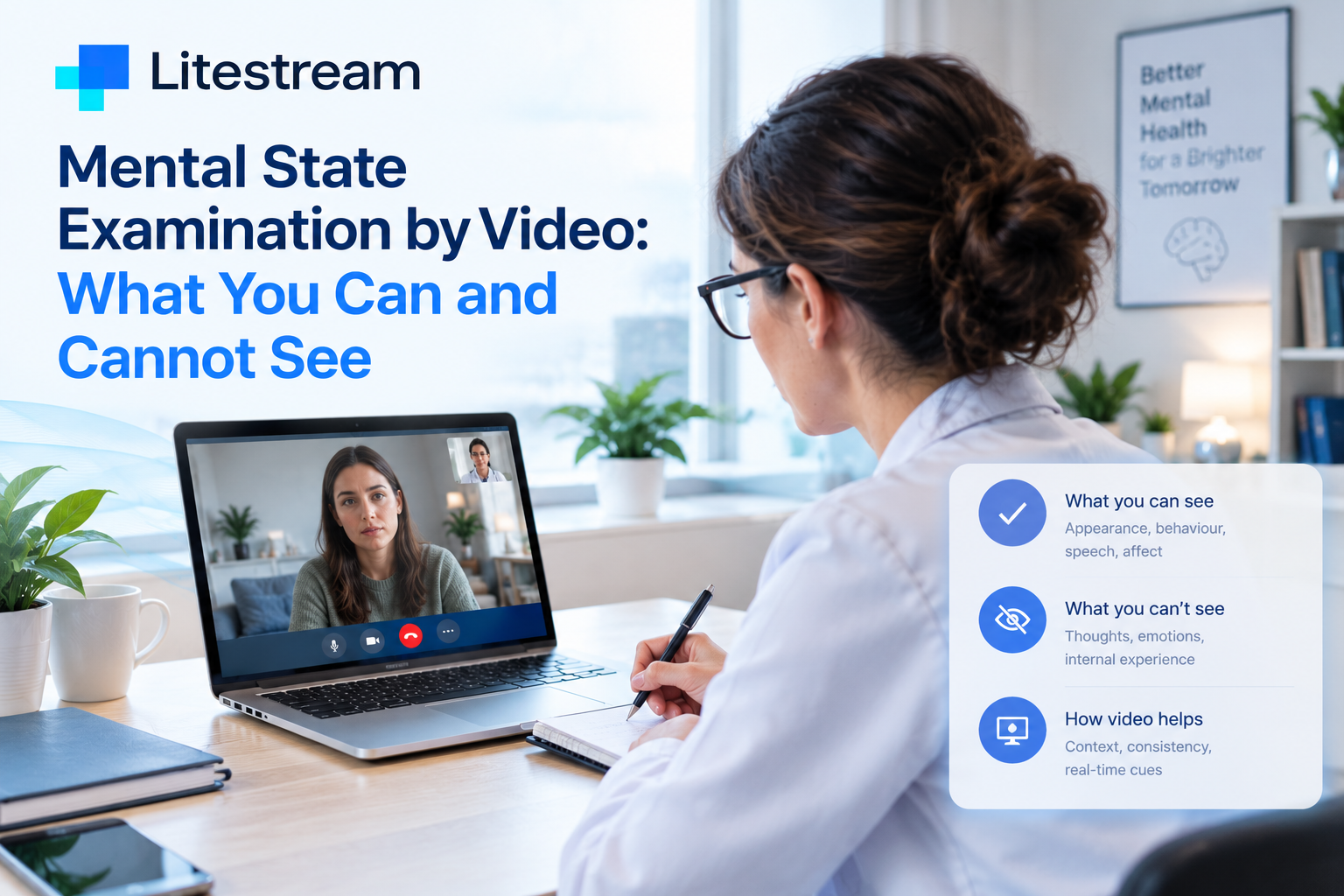
Mental State Examination by Video: What You Can and Cannot See
A mental state examination is mostly an act of observation. You are recording what the person in front of you looks like, how they hold themselves, how they move, what they do with their hands and their eyes, and how all of that sits against what they are telling you.
A video call hands you a rectangle containing a head and shoulders, lit by whatever is in the room. The question for anyone running remote mental health assessments is not whether that is worse than being there. It is which parts are affected, and what you can do about it.
The evidence is more reassuring than clinicians expect
Mental health does unusually well in comparisons of remote and in-person assessment. In the Mayo Clinic study of nearly 2,400 patients seen by video and then in person, psychiatry had the highest diagnostic agreement of any specialty at 96%.
A review of telepsychiatry in BJPsych Advances puts that in a wider context. Across small trials, diagnostic agreement between remote and in-person assessment ranged from 69% to 96%, and most structured rating tools perform similarly on video. Several randomised trials found telepsychiatry non-inferior for depression, though two of them found higher rates of antidepressant prescribing in the telemedicine groups. Results for post-traumatic stress disorder are mixed. One randomised trial found in-person care superior, for bulimia nervosa, with small differences.
The same review is candid that the overall evidence is of low quality and limited scope, and does not show clear superiority either way. That is the honest position: remote assessment is a reasonable tool for a lot of mental health work, and the uncertainty is about which patients and which presentations, not about whether it works at all.
The parts of the examination that depend on looking
The BJPsych Advances review makes the point crisply. The mental state examination divides into six categories, three of which rely on prolonged physical observation. Observing appearance, belongings and limb movement is, in the authors’ words, very difficult to do via video call and impossible to do via telephone.
In practical terms, this is what narrows:
- Appearance and self-care. You see a face and shoulders in whatever light the room provides. Clothing, grooming and general condition are partly visible at best.
- Belongings and surroundings. In a clinic you notice what someone brought with them. On video you see whatever is behind them, which may be a blurred background.
- Psychomotor activity. Agitation and retardation are whole-body observations. A static head-and-shoulders frame shows a fraction of it, and a poor connection turns real movement into stutter.
- Limb movement and tremor. Out of frame unless you ask, and degraded by low frame rates.
- Eye contact. Camera position means apparent eye contact is an artefact of where the lens sits, not where the person is looking.
Speech, mood as described, thought content and cognition travel better. They are carried by the conversation, which is the part video handles well.
What about the therapeutic relationship
This is the objection clinicians raise first, and the evidence is more nuanced than either camp claims. The same review cites a 2018 meta-analysis of five studies in which the therapeutic alliance was marginally less strong in remote care, but notes that this did not translate into worse outcomes.
Body posture, eye contact and non-verbal communication are all affected by remote delivery, and the authors accept that this can weaken the alliance. The useful conclusion is not that it does not matter, but that it is a reason to be deliberate about setup rather than a reason to abandon remote work.
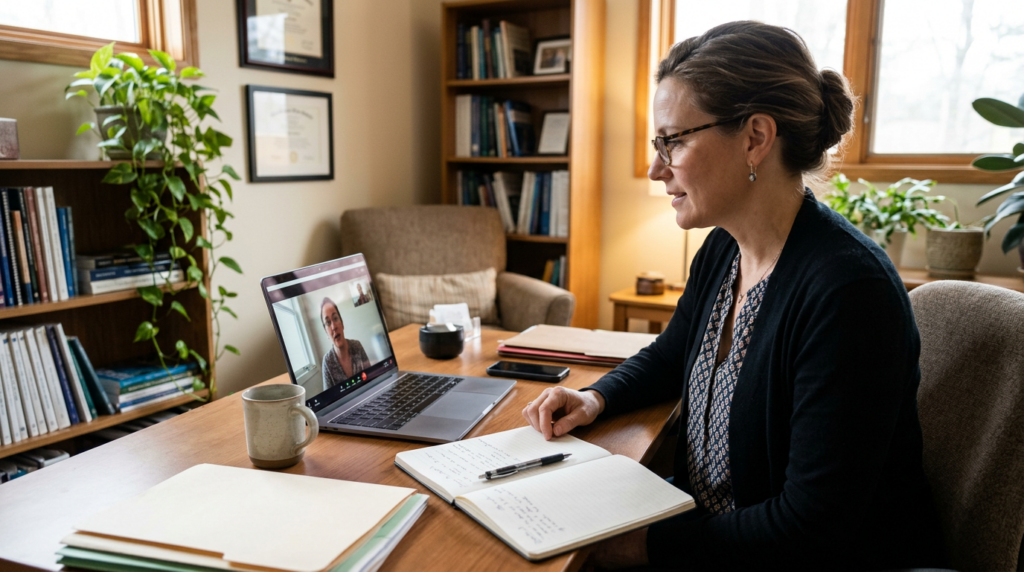
Setting up the consultation so the window is as wide as possible
The most specific published guidance on this comes from the Royal Australian and New Zealand College of Psychiatrists, in its professional practice guideline on telehealth in psychiatry. It is not Irish guidance, and it is written for a different regulatory system, but as a practical specification it is the clearest one available.
Your end
- A plain, neutral background, minimal distractions and adequate lighting.
- Check sound and picture quality before you start.
- Use a clinical platform rather than a personal account, and prefer one that hosts data locally where possible.
- Have a backup arrangement, such as a telephone, for when the technology fails.
The patient’s end
- Ask whether they consider their location safe and suitable, and discuss any privacy concerns.
- Where someone needs help to reach a suitable setting or to use the technology, that support is part of the service, not a precondition for it.
- Written instructions or a trial run before the first appointment remove a lot of first-appointment friction.
The guideline also takes a clear position on mode. Safe assessment generally requires that the patient can be visually observed, and initial assessments should be by video. Telephone is for when video is unavailable, and generally for well-known patients where clinical risk is low.
The things to establish before the clinical conversation starts
These are quick, and they are the ones a remote service most often leaves out.
Where the patient is, and a number for that location
The guideline advises collecting the patient’s address and the phone number for the place they are consulting from, and recording the location. If anything goes wrong, this is the information that matters.
Who else is present, and that the patient agrees
Record any additional people present and the patient’s consent to their presence. Carers are identified and supported as they would be in person. Interpreters, where not physically present, should join the consultation.
Whether the GP is aware, and what local service the patient can reach
Suitability for telehealth is assessed alongside whether carer contact details are available, whether the GP is aware, and whether the patient can access a local mental health service.
Consent to any recording
Recording a session requires the patient’s express informed consent. Note also that patients may record sessions themselves, with or without your knowledge.
One honest caveat on emergencies. The BJPsych Advances review describes remote management of psychiatric emergencies as essentially an untested field, and says there is no current evidence on whether community crisis teams can work remotely. Feasibility studies of emergency telepsychiatry have generally used a clinician physically in the room alongside a specialist assessing by video. A remote service should be built on the assumption that some situations need a person present.
Who remote assessment suits less well
The review and the guideline point to the same groups. Patients without the technology, the connection or the familiarity to use it. Patients without a private space in which to talk freely. Older patients, who were less likely to move from in-person to remote appointments. People with sensory or cognitive impairment, where suitability needs thinking about rather than assuming. And complex case management, which the review suggests is unlikely to work as well remotely.
The reasonable approach the authors land on is to let patients choose where possible, and to use a blended model where the evidence for a particular diagnostic group is uncertain. Remote and in-person are not a binary for a service that sees the same people over months.
What to write down
A remote mental health note carries everything a normal note does, plus a short set of facts about the consultation itself. The guideline suggests recording the medium used, the people present and the patient’s consent to their presence, the patient’s location, how long the consultation lasted, and any technical difficulties.
That last one matters more here than in most specialties. If the picture froze during the part of the consultation where you were watching for psychomotor change, that is clinical information, and it belongs in the record alongside what you did about it.
Where LiteStream fits, and where it does not
First, what it does not do. LiteStream does not assess, diagnose or score mental health conditions, and nothing in the platform is a substitute for clinical judgment. Any suggestion that software can read a patient’s mental state from a camera should be treated with suspicion.
What it does is widen and steady the window. The patent-pending low-bandwidth video is built to hold a usable picture on rural broadband and mobile data, which matters when frame rate is the thing standing between you and seeing psychomotor change. Patients join by a secure link or a six-character access code with no account and no download, which removes a common access barrier for people who are not confident with technology.
Alongside the call, the clinician workspace provides a live transcript and note drafting, so more of your attention is on the person and less on the keyboard. The clinician reviews and approves every note, and every clinical decision stays with the care team.
LiteStream is in working beta, and we are adding trial partners now.
Frequently asked questions
Is a mental health assessment by video as good as in person?
For diagnosis, the published comparisons are broadly reassuring. Psychiatry had the highest diagnostic agreement of any specialty in the largest multispecialty study, at 96%, and across smaller trials agreement ranged from 69% to 96%. The evidence base is acknowledged to be of low quality and limited scope, so it supports remote assessment as a reasonable option rather than as equivalent in every case.
What is hardest to assess in a mental state examination over video?
The parts that depend on prolonged physical observation: appearance and self-care, belongings and surroundings, psychomotor activity and limb movement. Apparent eye contact is also distorted by camera position.
Should a first appointment be by video or telephone?
Published professional guidance takes the view that safe assessment generally requires the patient to be visually observed and that initial assessments should be by video, with telephone reserved for when video is unavailable and generally for well-known patients at low clinical risk.
What should I establish before the clinical conversation starts?
Where the patient is and a phone number for that location, who else is in the room and whether the patient consents to their presence, whether their GP is aware, and what local service they can reach.
Does the therapeutic alliance suffer over video?
A meta-analysis of five studies found the alliance marginally less strong in remote care, but this did not translate into worse outcomes. It is a reason to be deliberate about setup rather than to avoid remote work.
This article summarises published research and professional guidance for clinicians. It is not clinical advice, and it is not guidance for patients. If you are struggling with your mental health, please contact your GP or a local mental health service.
Running remote mental health clinics? Request early access and join the clinician waitlist.
Sources
- Telepsychiatry: what clinicians need to know about digital mental healthcare. BJPsych Advances. https://www.cambridge.org/core/journals/bjpsych-advances/article/telepsychiatry-what-clinicians-need-to-know-about-digital-mental-healthcare/62FC203E6E8E763A15ED91DA9AFB76F3
- Royal Australian and New Zealand College of Psychiatrists. Professional Practice Guideline 19: Telehealth in psychiatry (October 2023). https://www.ranzcp.org/getmedia/2148dcf0-9fcd-4dc2-80bb-4bef2f44f2ca/ppg-19-telehealth-in-psychiatry-oct-2023-v2.pdf
- Demaerschalk BM, et al. Assessment of Clinician Diagnostic Concordance With Video Telemedicine in the Integrated Multispecialty Practice at Mayo Clinic. JAMA Network Open. 2022;5(9):e2229958. https://jamanetwork.com/journals/jamanetworkopen/fullarticle/2795871
- Medical Council of Ireland. Telemedicine: A Guide for Doctors. https://www.medicalcouncil.ie/existing-registrants-/telemedicine-a-guide-for-doctors/
- HSE. Telehealth Roadmap 2024-2027. https://about.hse.ie/publications/telehealth-roadmap-2024-2027/