Remote Chronic Disease Monitoring: Where Video Fits
A blood pressure reading tells you a number. It does not tell you that the patient looks worse than they did last month.
That gap is the interesting part of remote monitoring. The devices are good and getting cheaper, the data arrives reliably, and the dashboards are full. What decides whether any of it changes an outcome is what the service does with the numbers, and how much of the patient the team can actually see.
What remote monitoring in Ireland looks like now
This has moved from pilot to infrastructure in about two years.
The HSE virtual ward programme delivers acute, hospital-level care at home, with patients either discharged earlier or admitted to the virtual ward instead of a bed. It runs across sites including Our Lady of Lourdes in Drogheda, St Luke’s in Carlow and Kilkenny, the Mercy University Hospital in Cork, Galway University Hospital, Midland Regional in Tullamore, St Vincent’s in Dublin and University Hospital Limerick, covering pathways in cardiology, respiratory, general medicine, stroke, orthopaedics, rehabilitation, urology, gynaecology and infectious disease. The HSE reported more than 3,000 patients supported since the programme began in 2024.
Alongside it, the HSE has been procuring remote health monitoring for national rollout, with tender documents reported at around 15 million euro, covering respiratory, cardiology, endocrinology and maternity. The scale of the opportunity, on the HSE’s own estimate, is roughly 1.3 million people in Ireland living with a major chronic disease, of whom it expects 20 to 25 per cent could benefit.
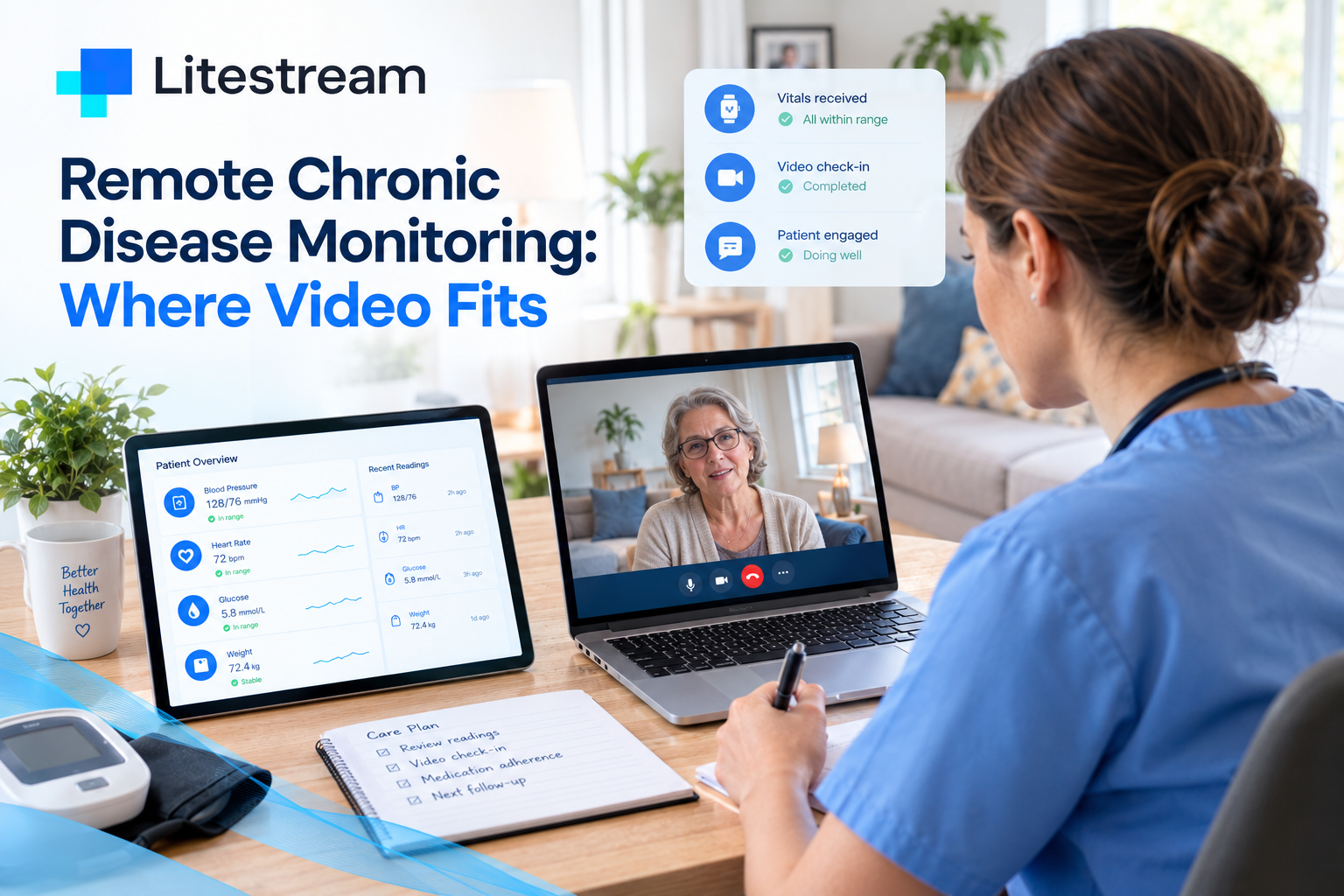
One detail in the virtual ward model is worth pausing on. Reporting on the programme described patients receiving a kit with monitors for blood pressure, temperature, oxygen saturation and ECG, plus a tablet for twice-daily calls or video contact with nursing staff, with the service staffed around the clock.
In other words, the model that is being built nationally already treats talking to and looking at the patient as part of monitoring, not as an optional extra. That is the right instinct, and the evidence supports it.
Collecting numbers is not the intervention
Two large randomised trials in heart failure make this point better than any argument.
BEAT-HF randomised 1,437 patients discharged after decompensated heart failure to usual care or an intervention of pre-discharge education, around nine nurse-led telephone coaching calls over six months, and daily home telemonitoring of weight, blood pressure, heart rate and symptoms, with centralised nurses reviewing the data and acting on threshold alerts. Readmission within 180 days occurred in 50.8 per cent of intervention patients and 49.2 per cent of usual care patients. No significant difference. The trial was published in JAMA Internal Medicine in 2016.
TIM-HF2 randomised 1,571 patients in Germany to remote patient management plus usual care, or usual care alone. The difference was in the service rather than the sensors: a telemedical centre staffed by physicians and heart failure nurses 24 hours a day, every day, able to change medication, arrange admission and provide education. The percentage of days lost to unplanned cardiovascular admission or death fell from 6.64 per cent to 4.88 per cent, and all-cause mortality fell from 11.34 to 7.86 per 100 person-years. Published in The Lancet in 2018.
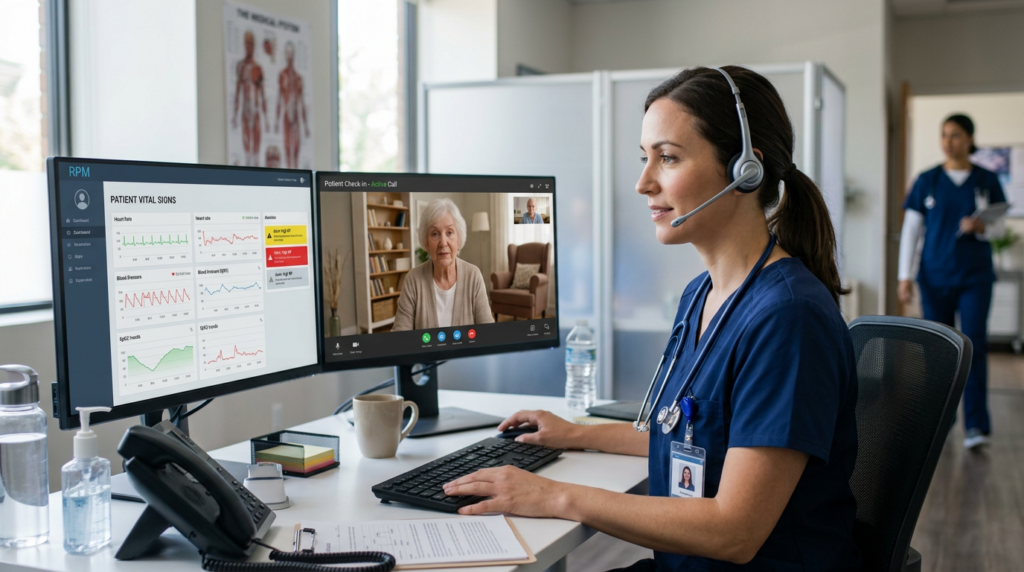
Both trials collected home readings. One changed outcomes and one did not. The difference was the clinical service wrapped around the data, and the authority of the people looking at it.
A caveat worth keeping: the TIM-HF2 benefit was driven mainly by lower mortality rather than fewer unplanned admissions, and the extended follow-up after the intervention stopped did not maintain the difference. Remote monitoring looks like an ongoing service, not a course of treatment.
What the numbers miss
Thresholds catch what they were set to catch. Several of the things that make an experienced clinician uneasy about a chronic disease patient are not in the dataset at all.
- How the patient looks. The general impression of someone who has deteriorated is a real clinical signal and an early one. It is the thing families notice first.
- Oedema. Weight trends are a proxy. Looking at the ankles is the observation.
- Work of breathing. A normal oxygen saturation sitting still at the kitchen table tells you less than watching someone speak in full sentences, or not.
- Skin and wounds. Colour change, a leg ulcer that is not healing, cellulitis at an early stage.
- Function. Whether someone can get out of a chair, and how much it costs them to do it.
- The environment and the regimen. Whether the medication boxes on the table match the list on the screen. Whether anyone is there to help.
None of this argues against devices. It argues that a monitoring service built only on numbers is working with one hand behind its back.
The moments where a scheduled video check-in earns its place
Not every contact needs to be video, and a service that insists on it will waste clinical time. These are the moments where seeing the patient changes what you do.
When a trend shifts
The numbers have moved but not enough to trigger anything. A short look at the patient is a cheap way to decide whether this is noise or the start of something.
Shortly after discharge
The highest-risk window, and the one where the gap between how someone reports feeling and how they look is widest.
After a change in medication
Tolerance, side effects and whether the patient has actually made the change are all easier to establish while looking at them.
Before deciding on admission
The decision that costs the most in both directions. Seeing the patient narrows it.
When the patient or family asks for contact
A request for reassurance is itself information, and it is often the first alert the system gets.
Tracking visual change over time
Chronic disease is a question about trajectory, not a snapshot. That is exactly how numbers are used: a weight today means little, a weight trend means a lot.
Visual information is rarely treated the same way, mostly because it has been hard to capture consistently. A clinician remembers the last consultation imperfectly, and a note that says the patient looked well is not comparable with anything. If visual observations were recorded in a structured and consistent way at each contact, the same trajectory logic would apply to them.
That is a reasonable thing to want from a remote monitoring service, and a reasonable thing to ask a vendor whether they support.
Practical notes for a service
- Decide who reviews what, and when. A dashboard nobody owns is the commonest failure mode. Both heart failure trials had nurses reviewing data; only one gave the team the authority to act on it.
- Set a clear route from an alert to a human. Threshold alerts are the start of a clinical process, not the end of one.
- Treat a video check-in as a clinical contact. It needs a note, and the note should record what you could and could not assess.
- Expect connection quality to vary. Patients on rural broadband or mobile data are often the same patients a virtual ward is trying to keep out of hospital.
- Agree in advance when a remote contact converts to an in-person visit, and make that route quick.
Where LiteStream fits
LiteStream is not a monitoring platform, and it does not read devices. What it does is make the looking part of a remote service better.
The patent-pending low-bandwidth video is designed to hold a usable picture on rural broadband and mobile data. Patients join by a secure link or a six-character access code with no account and no download, which matters when the cohort is older and the alternative is a hospital bed. During the call, the workspace flags potential visual concerns for the clinician to evaluate, produces a live transcript and drafts the note. The clinician approves everything.
LiteStream is in working beta, and we are adding trial partners now.
Frequently asked questions
Does remote monitoring reduce hospital admissions?
The evidence is mixed and the service design seems to matter more than the devices. BEAT-HF, which combined nurse coaching calls with daily home telemonitoring and threshold alerts, found no difference in 180-day readmission. TIM-HF2, which added a round-the-clock telemedical centre able to change medication and arrange admission, reduced days lost to unplanned cardiovascular admission or death and reduced all-cause mortality.
What is a virtual ward?
A model where a patient receives acute, hospital-level care at home instead of in a bed, under a hospital team, usually with monitoring equipment and regular contact. The HSE has run virtual wards since 2024 and reported more than 3,000 patients supported.
Why add video to a monitoring service that already collects vital signs?
Because several of the signals that make clinicians uneasy are visual: how the patient looks, oedema, work of breathing, skin changes, and function. Those are not in the dataset.
Should every remote monitoring contact be a video call?
No. Video earns its place at specific moments: shortly after discharge, after a change in medication, when a trend shifts without triggering an alert, and when an admission decision is in play.
Building a remote monitoring or virtual ward service? Request early access and join the clinician waitlist.
Sources
- HSE. Virtual Wards: supporting care at home. https://about.hse.ie/news/virtual-wards-supporting-care-at-home/
- Medical Independent. HSE to roll out remote health monitoring nationwide in 2026. https://www.medicalindependent.ie/in-the-news/hse-to-roll-out-remote-health-monitoring-nationwide-in-2026/
- Irish Examiner. HSE expands virtual ward service (December 2025). https://www.irishexaminer.com/news/arid-41762699.html
- Ong MK, et al. Effectiveness of Remote Patient Monitoring After Discharge of Hospitalized Patients With Heart Failure: the BEAT-HF randomized clinical trial. JAMA Internal Medicine. 2016;176(3):310-318. https://jamanetwork.com/journals/jamainternalmedicine/fullarticle/2484299
- Koehler F, et al. Efficacy of telemedical interventional management in patients with heart failure (TIM-HF2): a randomised, controlled, parallel-group, unmasked trial. The Lancet. 2018. https://www.sciencedirect.com/science/article/abs/pii/S0140673618318804
- HSE. Telehealth Roadmap 2024-2027. https://about.hse.ie/publications/telehealth-roadmap-2024-2027/